For agencies & aggregators
One login.
Every client sealed
from every other.
Profit, tax and inventory for each seller account you manage. Separate books, separate currencies, separate tax positions, and an isolation boundary that lives in the database rather than in a query somebody remembered to write.
Every account you manage, walked through with you. Tell us how many sellers you run and we will show you the setup on yours.
Straight answers
- Are clients really separated?
- Yes, and it is enforced by the database rather than by application discipline, so a mistake in our code cannot cross between clients.
- Can one login hold several clients?
- Yes. You switch between the accounts you have been granted, and nothing outside them is reachable.
- How do clients join?
- You invite them; they follow a one-time link and connect their own Amazon account.
- What does it cost?
- Per connected account. The number depends on how many, so we quote it.
A client list, not a merged ledger
Marketplaces consolidate; client accounts must never. Most tools treat that difference as a filter you can switch off.
Isolation the database enforces
One filter bug in most tools shows client A's revenue to client B. Here separation is enforced by the database itself and verified on every release.
Separate books, separate currencies
Each client keeps its own currency, marketplaces and cost basis. Nothing is ever summed across clients.
Separate tax positions
VAT per client, from that client's own transactions and registrations. No shared rate tables, no shared returns.
Onboarding without holding passwords
You invite; the client connects their own Amazon account. No shared credentials for you to store, rotate, or be blamed for.
One login, every client
Switch accounts from the sidebar without signing out. The client's name stays on screen, so you always know whose figures you are reading.
Priced per connected account
Not per seat, not per marketplace. Per Amazon account you connect — the thing that actually costs compute.
Isolation
The boundary is in the database, not in our good intentions.
“Every service remembers to filter by client” is discipline, and discipline is not a guarantee. One forgotten condition in one query puts one client's revenue on another client's screen, which, for an agency, is the single worst thing this software could do. So the guarantee lives one level below the code that could forget.
Database-enforced separation on every client-scoped table
A policy governs reads and writes alike, so a request can neither see nor create a row outside the client it is acting for.
Separation enforced beneath the application, not by it
The API connects as a role the policies apply to, not as the owner, who would bypass them. Migrations and backups are separate, deliberately.
It fails closed
A connection that has not declared which client it is acting for matches no rows at all. The failure mode is an empty screen, never somebody else's figures.
Sign-in tables are out of reach entirely
The users and token tables are revoked from that role outright, so a client-scoped request cannot read them under any policy.
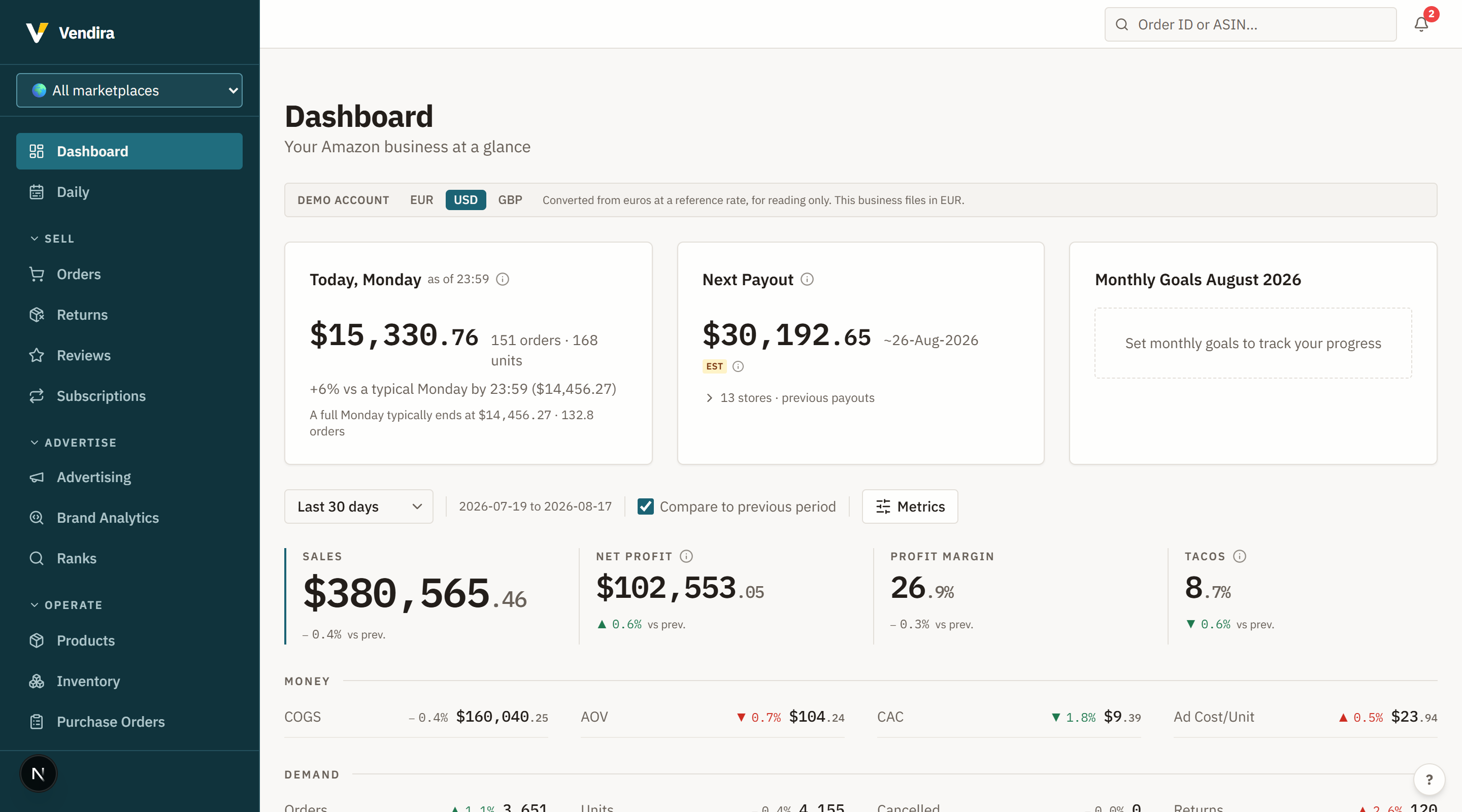
One client's P&L. There is no view in the product that adds this to another client's, deliberately.
Onboarding
A client joins by invitation.
There is no public sign-up form for a client account and no password anywhere in the system, sign-in is a one-time link, so there is nothing to phish, reuse or reset, and nothing for you to hold on a client's behalf.
You add the client
A new account is created for them, empty and sealed from every other from the first row.
They follow the invitation
A one-time link, valid for a limited window. If it lapses, you re-issue it.
They connect Amazon themselves
The seller authorises their own Selling Partner and Advertising accounts. You never handle their Amazon credentials.
History imports and the books open
Orders, fees, settlements, advertising and stock come in, and the figures start reconciling.
Precisely, on the multi-account login
Switching is yours. Adding an account is still ours.
What is built and running today is everything above this box: the isolation, the per-client books, and one login that moves between the client accounts you manage. What is not built is self-serve — there is no signup, and no form where you add a client account to your own login.
So your roster is set with us, when you come on board and whenever it changes; from then on you switch between those accounts yourself, as often as you like. Your login can only ever reach the accounts on that roster: every request re-checks it, so removing one takes effect on the next page rather than whenever a session happens to end.
We would rather you read that here than find it out after paying. It is the same reason the pricing page says our statutory filing engine is Spain today.
Pricing
Per connected account. Custom, and we mean it.
Single-seller plans are banded by monthly order count, and every feature is in every band. An agency is not that shape: your cost to us scales with the number of Amazon accounts connected and the volume flowing through them, so that is what the price is built from.
There is no number printed here, and that is deliberate rather than coy, a figure we invented for a page would be wrong for almost every roster that read it. Tell us how many accounts and roughly what they turn over, and you get a real one back.
Included for every client account
- Every European and North American marketplace
- Profit & loss, reconciled to the cent
- FIFO cost of goods with landed freight and customs
- Advertising profitability after product cost
- Reorder dates and cash tied up in stock
- VAT computed for every country they sell in
- Unlimited users on each client account
- CSV export of everything, always
On tax, precisely: VAT is computed for every country a client sells in, anywhere in Europe. Filing the statutory forms from inside the product, the Modelos, the Libros Registro, the AEAT calendar, is Spain today. If your roster files elsewhere, they get the computed figures and books for their accountant, and we would rather say so on this page than at renewal.